

Who Was There When We Were Not? The Activities of The Upper-Class Ottoman Muslim Women in Vienna during WWI


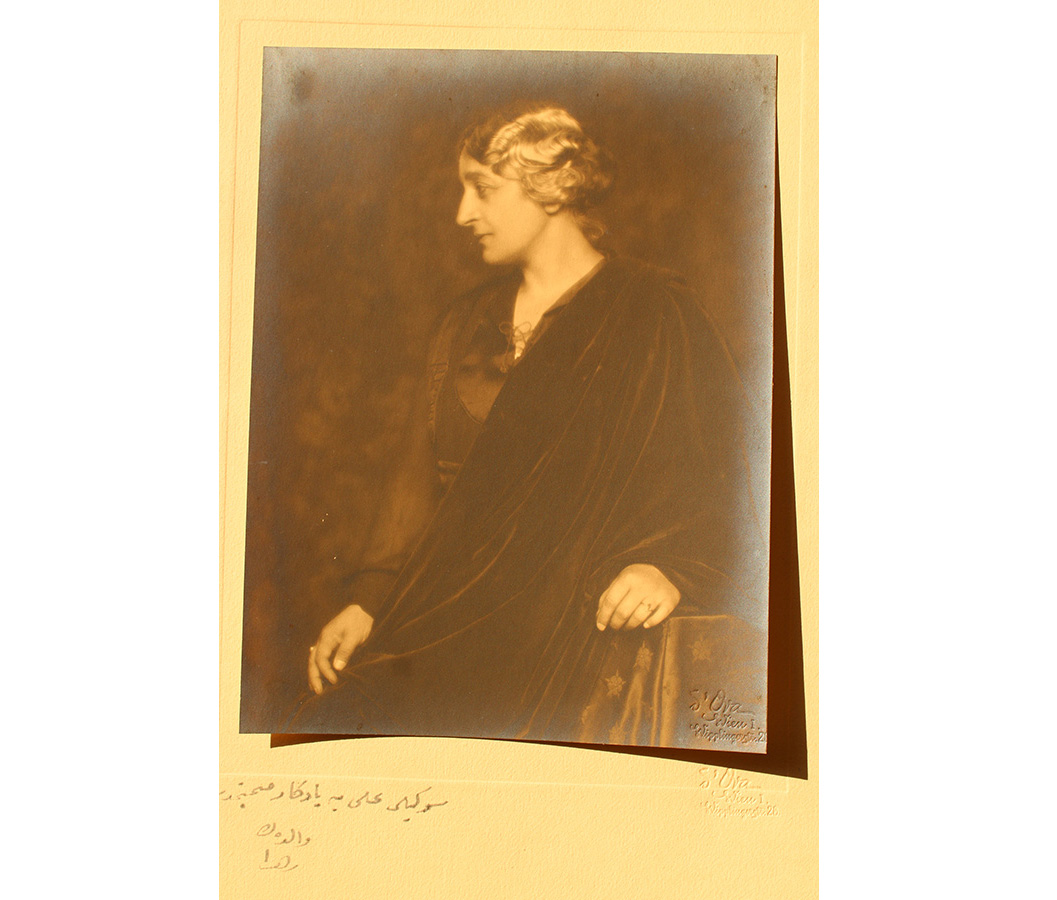

The following text is based on my latest research inspired by the passport of a Muslim woman who applied for a visa to travel to Vienna from Istanbul in 1917. 1 When I encountered this passport in the Presidential Ottoman Archive in Istanbul, I was conducting research for my master’s studies and waiting for my own visa application from the Austrian authorities to continue my studies at the University of Vienna. This encounter made me curious about earlier histories of migration from today’s Turkey to Austria. Migration between the two countries is usually discussed as a phenomenon of the post-WWII period, when the economic imbalance between both regions grew drastically. I wanted to deepen our knowledge of migration between these two cities, especially women’s migration, during WWI, a time when the two empires were allies.
As an outcome of my research, I found that there was a small group of elite Ottoman Muslim women who lived in and traveled to Vienna for temporary stays during WWI. Although their stays were short, these women established social networks both among themselves as Ottoman Muslim women and with local Austrian women. Unfortunately, I could not find any information about women from the popular classes in any of the archives in which I conducted my research, neither in Austria nor Turkey. Finding women in the official archives is always a challenge, since the information related to women is always kept secondarily, and they are usually registered under their male family members. Researching women in the context of a country, of which they were not citizens, presents particular challenges as they were persistently simultaneously subject to both the constraints of patriarchal practices in bureaucratic documentation and to the limitations imposed by their temporary presence within that country. Moreover, women’s travel and accommodation conditions might differ from their male counterparts. For example, I could not deepen my knowledge of the unique student Sabiha Hanım2, because she is not listed in any historical register, neither in Istanbul nor in Vienna. However, the name lists of Ottoman male pupils, who moved to Vienna as a part of the educational program run by the Oriental-Department of the Austro-Hungarian Empire, are available for historical research at the Austrian State Archives in Vienna. Female students were excluded from these programs. For this reason, the information about these elite Ottoman women is only limited to archives in Istanbul.
Historical documents such as travel records, passports, and civil society records demonstrate that thirty-three Ottoman Muslim women moved to or travelled to Vienna during WWI. Some travelled to Austria for medical treatment, some for education, as Sabiha Hanım did, and others moved to Vienna as family members of Ottoman diplomats. In addition to the historical documents in the Presidential Ottoman Archive in Istanbul, the rich family archive and collections related to the family of the Ottoman Ambassador Hüseyin Hilmi Pasha provide significant information about his wife, Fatma Zehra Hanım, and daughter, Ayşe Aliye Hanım. Fatma Zehra Hanım stands at the core of this study because of her primary role as head of the Women’s Branch of the Ottoman Red Crescent in Vienna and her engagement with Viennese urban culture.3
The Women’s Association of the Ottoman Red Crescent in Vienna
The Women’s Association of the Ottoman Red Crescent in Vienna (Frauenverein vom Ottomanischen Roten Halbmond in Wien, FvORH afterwards) officially began its activities on November 25, 1916 and continued its activities until January 1, 1918. (FvORH, 1912,1) Fatma Zehra Hanım held the presidential position, while approximately ten other Muslim women, including Adile Hanım, Vildan Hanım, and Nazlı Hanım, served on the executive board. The first Aid Committee for the Ottoman Red Crescent had been established on March 9, 1912. As women’s mobility across the countries involved in WWI increased, Ottoman and Austro-Hungarian authorities encouraged Ottoman women in Vienna to organize, aiming to strengthen relations between the two countries. The first attempts to establish the Women’s Committee for the Turkish Red Crescent was taken under the leadership of Baroness Burián von Rajecz (1851–1922), the wife of the Austro-Hungarian Foreign Minister, in 1915. (Şimşek, 2023, 306) One year later, Ottoman Muslim women took the initiative to transform the committee into an association. After its formation, “all Turkish women in Vienna participated in the newly initiated promotional activities of the association,” as mentioned in a self-printed booklet about its activities. (FvORH, 1917, 4) While the majority of the board members were Muslim women, non-Muslim Ottoman women and Austro-Hungarian women also took part.
The association’s headquarters were located at Schwarzenbergplatz 5 in the first district, the commercial and governmental center of Vienna. Its mission was defined as collecting donations for the Turkish Red Crescent and promoting friendship with Turkey. To achieve this, Muslim women sent approximately 14,500 letters from upper-class households to ordinary Viennese homes. (FvORH, 1917, 16) The sheer number of letters demonstrates the impressive reach of their networks. In addition to this, the association organized public events such as receptions and lectures to support the Ottoman soldiers, families, and children injured and affected by the war. (FvORH, 1917, 7) Small articles about the activities of Ottoman Muslim women were also published in the Viennese press, including the Neues Wiener Tagblatt, Fremden-Blatt, and Reichspost, as identified by Muttalip Şimşek’s detailed research in these newspapers. (Şimşek, 2022, 401)
The income of the association depended on membership fees, donations collected through campaigns, and events. The total income of the association between 1916 and 1917 amounted to 141,231.20 Kronen, with a remaining balance of 65,955.20 Kronen in 1917. (FvORH, 1917, 14) The income of the association covered the costs of running the association, organizing events, and supporting the Ottoman target group of the organization’s charity purpose, both in the Austro-Hungarian and Ottoman Empires. These activities demonstrate that elite Ottoman women were highly involved in upper-class Viennese society.
Fatma Zehra Hanım and her social network
Fatma Zehra Hanım moved to Vienna in 1912 at the age of thirty, and Ayşe Aliye Hanım was at the age of eleven. Private letters from Fatma Zehra Hanım and her family to relatives in Istanbul show that she and the wives of other Ottoman officials active in the association were part of a broader social network. Those who travelled to Istanbul to visit, usually via the Balkan train at the time, brought back to Vienna tastes of home such as lemons, jams and beauty products such as Istanbul rastığı, a coal used by women to darken the color of their eyebrows.4 They also carried greetings and checked on the well-being of friends and relatives in Istanbul. This demonstrates their participation in a transnational “care circle.”
On the other hand, these private letters also reveal that Fatma Zehra Hanım (image 1) and Ayşe Aliye Hanım (image 2) were closely engaged with Viennese urban life. The family participated in the city’s cultural and artistic activities, such as opera, theatre, and cinema, and enjoyed spending time in the city’s parks, living much like their Viennese peers of the same class. The most striking items in this private archive, however, are the photographs of Fatma Zehra Hanım (Image 2) and her daughter taken in Vienna by famous modernist women photographers of the period, such as Madame D’Ora (1881–1963), Martha Fein (1894–1942), and Edith Barakovich (1896–1940). While Fein and Barakovich visited the family home to take private photographs, the studio portraits taken by Madame D’Ora are especially notable.
In these images, we see Ottoman women who wore the çarşaf5 as outdoor clothing posing without it in Madame D’Ora’s studio. Muslim women often posed without their outdoor coverings in studios-and for female photographers-in the Ottoman Empire. However, the confidence and elegance displayed in Madame D’Ora’s studio reveal both professional artistry and mutual trust between the sitters and the photographer. In these portraits, we see two Ottoman Muslim women presenting their beauty, strong posture, and willingness to pose for the camera and reveal their bodies as they wished – just as their peers in Istanbul did.
Conclusion
This study set out to deepen the history of women who migrated from Istanbul to Vienna. Although there was no mass migration during the First World War, developments in transportation, such as the Balkan train, and the wartime alliance between the Ottoman Empire and Austria-Hungary increased women’s mobility. Moreover, the passport and travel-control systems developed during the war, particularly-toward its end, allow us to trace the movements of these women. As a result, we know that, even if only in small numbers, a group of elite Muslim women migrated from Ottoman Istanbul to Vienna. These women not only founded civil society organizations to respond to wartime needs but also became part of Viennese cultural life, while establishing social networks among themselves. Although times and needs have changed in the age of mass migration and communication, this study shows that the tools women use to shape and enact their identities, images, and emotions—both in public and in the so-called private spheres, at home and abroad—have remained remarkably consistent: civil society organizations and friendship groups. It underlines the enduring importance of such semi-formal and informal organizations in women’s lives.
Bibliography
Frauenverein vom Ottomanischen Roten Halbmond in Wien (Women’s Association of the Ottoman Red Crescent in Vienna). Vienna: Self-published, 1917.
Şimşek, Muttalip. “Women’s Center of the Red Crescent Society in Vienna and Its Activities,” Atatürk Research Center Journal, no. 106 (Fall 2022): pp. 391–430.
Şimşek, Muttalip. “The Vienna Representation of the Red Crescent,” Atatürk Research Center Journal, no. 108 (Fall 2023): pp. 295–328.
Footnotes
1. This research has been supported by the scientific research grant of the Cultural Department of City of Vienna.
2. “El yevm Viyana Darülfunun-u Tıb Fakültesine müdavim bir Türk kızı “Sabiha Hanım” (A Turkish Girl ‘Lady Sabiha’ who is registered in The Medical Faculty at the Viyana University).” Kadınlar Dünyası 167 (30 March 1918); Hanım means Lady in Turkish.
3. The Ottoman Red Crescent Society was founded on April 14, 1877. Its Women’s Center was established later, on March 20, 1912. The Red Crescent provided opportunities for employment and skill development for women during the First Balkan Wars (1912-1913) and WWI (1914-1918).
4. The Balkan train run between January 1916 and October 1918. It aimed to connect Central Powers. The route of the train passed Istanbul, Sofia, Belgrade, Vienna, Dresden, and Berlin.
5. The most fashionable form of outdoor attire among modern Ottoman Muslim women at the time, primarily designed to cover the entire body, but varying in color and style according to the wearer’s preference. (see image 2)
About the Title: This title of the article is inspired by the phenomenal book of Cemal Kafadar, Kim varmış biz burada yoğiken?; Cemal Kafadar, Kim Var İmiş Biz Burada Yoğ İken: Dört Osmanlı: Yeniçeri, Tüccar, Derviş ve Hatun (İstanbul: Metis Yayınları, 2009).