

Imagining Spaces for a Decolonisation of Technology


On 26th September 2025 the webinar “Imagining Spaces for the decolonization of Technology” was held as part of series of events for the project from migrazine and Verein maiz, focusing on counter-narratives and alternative practices of resisting within the digital space. Luiza Prado and Rebecca Ryakitimbo were invited to share with us their positionalities and expertise on the topic.
migrazine
One of the pillar groundings in maiz is decolonization. We try to deal with this concept not only as theory, but also as a practice, as much as possible, while living in a European context where coloniality is part of the norm. With our projects, practice and approach, we put into question the normalization of Eurocentric ideals, and valorize other forms of knowledge production, resisting the colonial eagerness for homogeneity.
Could you expand on what decolonization of technology means for you, specifically of the digital space? Or if at all, is this actually possible? Which would be the very first steps that encourage alternatives to the hegemonical use of digital tools? And, at the same time, what will be the challenges?
Luiza Prado
I have been working in my own artistic practice as a scholar and a writer around topics of decolonization for a long time. 10 years ago decolonisation wasn't as trendy as it has become since. We are talking about a struggle of 500 years of history. So, it's not a simple process. Coloniality was an extensive project of a complete reorganization of reality. It established a racial hierarchy. It established a moral, religious, spiritual, epistemological, ontological justification for the domination of Europe over everyone else, and, of course, that extended to the domination of humans over other beings with whom we share this earth: plants, animals, as it justified the domination and ownership of territories. The work of decolonizing is a long work —I wouldn't even say of undoing, because that which has been done cannot be undone,— but a work of thinking what else is possible. I don't see it as a practice of going back to a state of purity and origin, but as finding and having the imagination to find. This is why I find art so important in its ability to propose to think otherwise.
When we talk about technology doing real harm to communities, to landscapes, to all the beings with whom we share the earth, I think of decolonization as a practice of trying to understand and work around the problems that we have (whether it is a data center, dependence on communication platforms, etc ). I also think it's a collective process because fighting against 500 years of history is not something one can do as an individual.
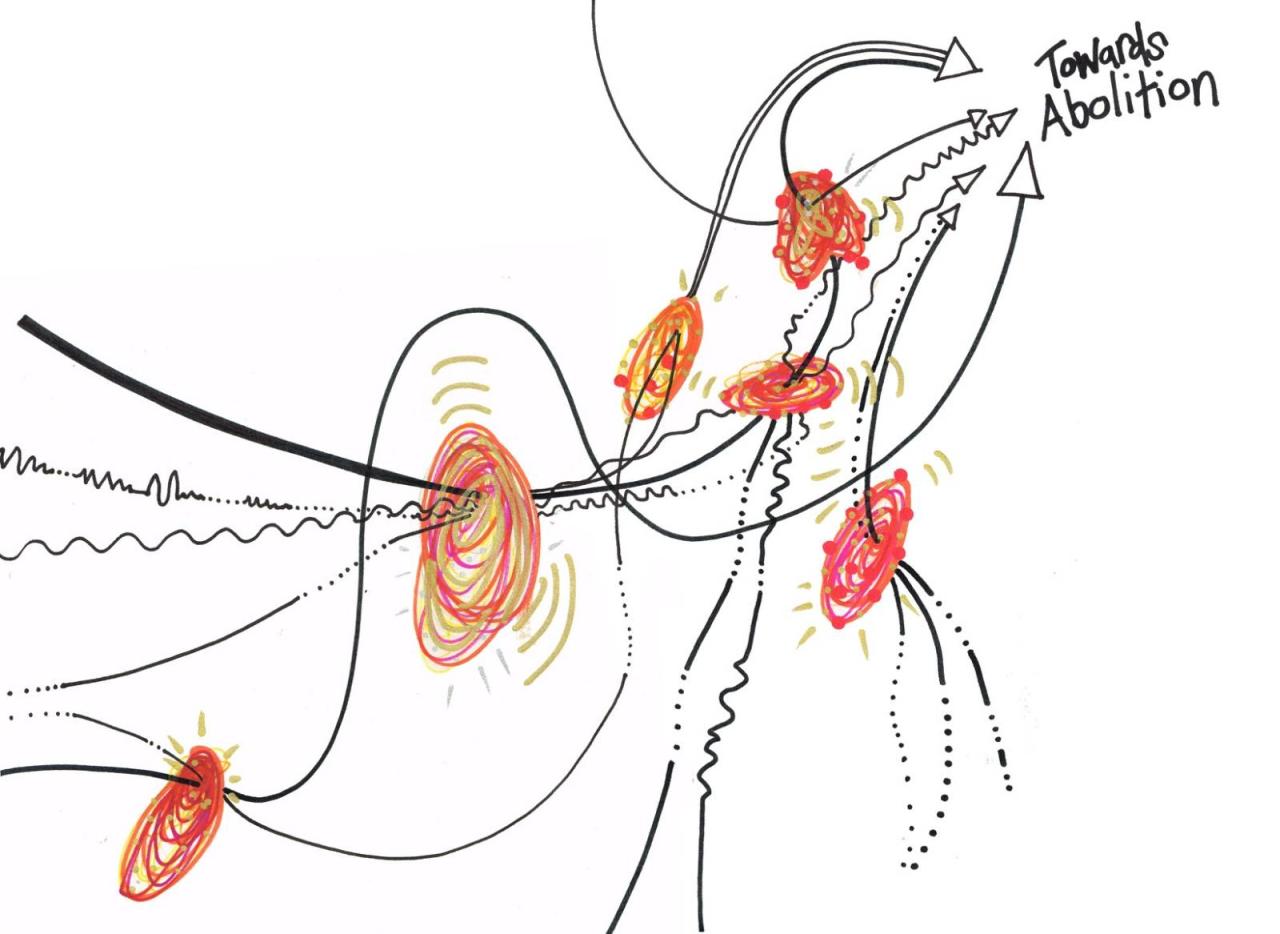
I would like to bring the work of prison abolitionists Mariame Kaba and Ruth Wilson Gilmore which inspires me because of what they ask in their practice and activist work: what else is possible besides the prison industrial complex to deal with harm within communities?
So, for me, decolonization, particularly in relation to technology, is part of a collective process, where we understand our limitations, the fragilities present, and we try to negotiate and push forward and expand the imagination, so to say, rehearse a training of a spell break.
Rebecca Ryakitimbo
First of all, the technology that we have doesn't give us alternatives. When you buy an Android phone, it comes already with Gmail in it. You hardly can opt out of a specific technology, because of how interlinked they are. I think one of the steps to decolonization is for communities to have alternatives that are not centralized towards these technologies that carry histories of colonialization, capitalism, patriarchy, all of which harm communities.
For me, to start thinking about decolonizing technology, means asking how do we have more independence from the mainstream technology that we use. How do we bring more ownership to the communities?
We also need to consider how best can we lay the foundation that will allow for the alternatives to thrive and how they can be brought to the forefront. Not just from the market perspective, but from one where people have a say and a voice in the process. How do we really center the people in the conversation, instead of profits? From my perspective, decolonizing technology begins with this practice of decentering.
migrazine
Thank you. I think there is also not a perfect way to embrace this long-term project of decolonizing. I would add to what you are saying that decolonization needs (re)education, and the possibility of spaces of reflection and encounter. Because the hardest thing is for people to arrive to alternative ways and tools outside of what the hegemonic market offers. Thus, an education that supports, as has been mentioned, a (re)learning to imagine is key. Within this system and its automated way of thinking and living, this passive way of consuming, we have the risk of annihilating imagination.
Moving towards art, narration, and other creative forms of breaking down information in a more accessible way, I would like you to elaborate on how we can use art, narration, and media as a tool to mediate critical information. How and why do you think we can use art and media for political education, for radical optimism? If we can, please share concrete examples of narratives which are intervening on dominant ways of telling a story.
Rebecca Ryakitimbo
As for where I come from, a lot of African communities have centered their knowledge on oral tradition for passing down knowledge from generation to generation. They have used stories, folk tales and poetry to communicate within their communities. I have this memory of my dad singing a song they used to sing in the public sphere before the independence of the country. People would be singing that they were going to remove the colonizers, regain our country and set up our own flag. They were moral kind of songs, but they kept the community engaged in the movement towards independence. People felt they were part of the process, because they were collectively singing about it. With the song, they also were passing down information on how they used to coexist before colonialism, with their own infrastructure and technologies.
Art is a useful tool to communicate to the communities around us and give them a feel of ownership. Anyone, despite their literary level, whether they're well educated or not, can communicate with art. If people can understand art; they can find some kind of connection.
I've had more success using comics to explain complex AI technology to communities than giving academic definitions, because it doesn't relate to the context of their communities. Bringing information in a story or artistic form, breaks down those barriers. This approach also moves away from colonialism, because the colonial mindset has specific ideals and standards for the communities, without taking into account how people were passing knowledge or were communicating before colonizers arrived.
Luiza Prado
I just want to reinforce what Rebecca says, knowing I'm biased, but I do think that art provides such an important avenue. Art in all its forms: music, visual art, performance art. Different kinds of performance art are also technologies that transmit different embodied knowledges that often sit outside and question the very colonial understandings of what constitutes real knowledge.
I've been, for instance, really interested in how technology is being used, explored, approached and framed in the context of Carnival in Rio de Janeiro. The parades on TV are the endeavors of a whole community of people that come together to build, to sew, to think about the dramaturgy, to think about the music and the themes that they're going to approach, and present to the public every year.
It's a collection of so many different kinds of knowledges put into really inventive, critical, and often quite unexpected ways. I have been thinking about what that means for the future. I feel that art also has the ability of projecting things towards the future. Whenever we put something out into the world, we're proposing ideas and opening pathways.
migrazine
I like how you put art as a tool to open towards new visions, which also connect past, present and future in one narration. Thank you.
You both come from places with different social, political, economic realities; however you are both deeply embedded in a structure sustained by capitalism and neocolonialism. We know technology is implicated in a deathly model of extractivism of the so-called “resources” (I agree this word is an approach that excels profit towards the beings and elements with which we coexist) and both of your regions are deeply affected by this. However, it’s encouraged in our societies to follow a path of hyper digitalization as a means for accessibility. But we know that accessibility, that “better future”, will still be restricted to a few as long as the racist and classist structure is kept the same. So, I wonder what actually is the future that we can look towards to. A future where we can have a reciprocal life, more similar to how life has been lived ancestrally on Indigenous lands, where human life exists aligned with the acknowledgement and gratefulness for everything that is surrounding us. In other words, how could we flourish in the future – if we do- taking into account reciprocity for both the digital and the physical spaces?
Rebecca Ryakitimbo
We need to start with acknowledging the damage that has been done, as Luiza said, how this affects our present, and how it will affect our future. Not as a compensation for the wrongs done, but for the community to feel that their experiences are valued, the challenges they experienced being considered and put into perspective. Because one of the challenges, for example, with colonialism is there's not a lot of recognition of the impact. This is the same with the slave trade, there's not a lot of recognition from the oppressors towards the victims. There is a lack of accountability and reparations to the victims. So, for us to look into the future, we need to acknowledge the past, learn from it and see how best can we improve in the circumstances that we currently find ourselves in.
For me, it is crucial to ask: Who is not part of the conversation about technology? Whose voice is missing? Whose perspective is being excluded? Who are the people who are benefiting? How can we have more downstream impact instead of upstream? How can we build from the ground up and ensure representation of the communities? There are things we cannot break, but we can build from where we are to decentralize power. This is how we can have inclusive participation of communities. This is how we can have community-led governance. I think of inclusive tech as feminist, grounded in the people, and in social and gender justice and equity.
I want to imagine the future where technology is a tool that can be used not only for resistance, but also for growth, for development, but more importantly, I want to see technology as a space that everyone feels acknowledged and held with care. Because I think that's something that can help to build a future that allows everyone to be part of that process, something which colonialism did not give us.
Luiza Prado
I think your point about acknowledgement is so important, Rebecca. I think whenever we're dealing with problems that come from the ruins and the rubble of colonization, understanding and recognizing that impact is a fundamental first step.
I am optimistic because in a way it is our duty to be. Going back to Mariame Kaba, she points out that hope is a discipline. It's not something that comes down from the sky as if you're blessed with it. One has to practice hope and the ability to find other pathways, other routes, other ways of doing things. This practice of hope also entails building community. But I think community is a word that is thrown around very nonchalantly. Community is not formed because people are in the same room... Community requires patience, a lot of work and negotiation. Sometimes you have to be in community with people that you don't fully agree with. That's also important because ultimately, you're working towards a common goal, even if you don't personally or specifically agree on certain points or even personally like each other. I think we're learning that, learning about community building, community sustaining. I would say that it is also part of the feminist and anticolonial practices related to our engagement with technology, and every aspect of our lives. Ultimately for me, it comes down to building and sustaining these relationships that forms the foundations of this ability to imagine a more just future.
Interview moderated and edited by Lia Kastiyo-Spinósa with the help of AI Speech-Text Transcription Tool from Speechnotes.co