

Fragments on Student (International) Solidarity in Serbia as a Powerful Counter-Narrative


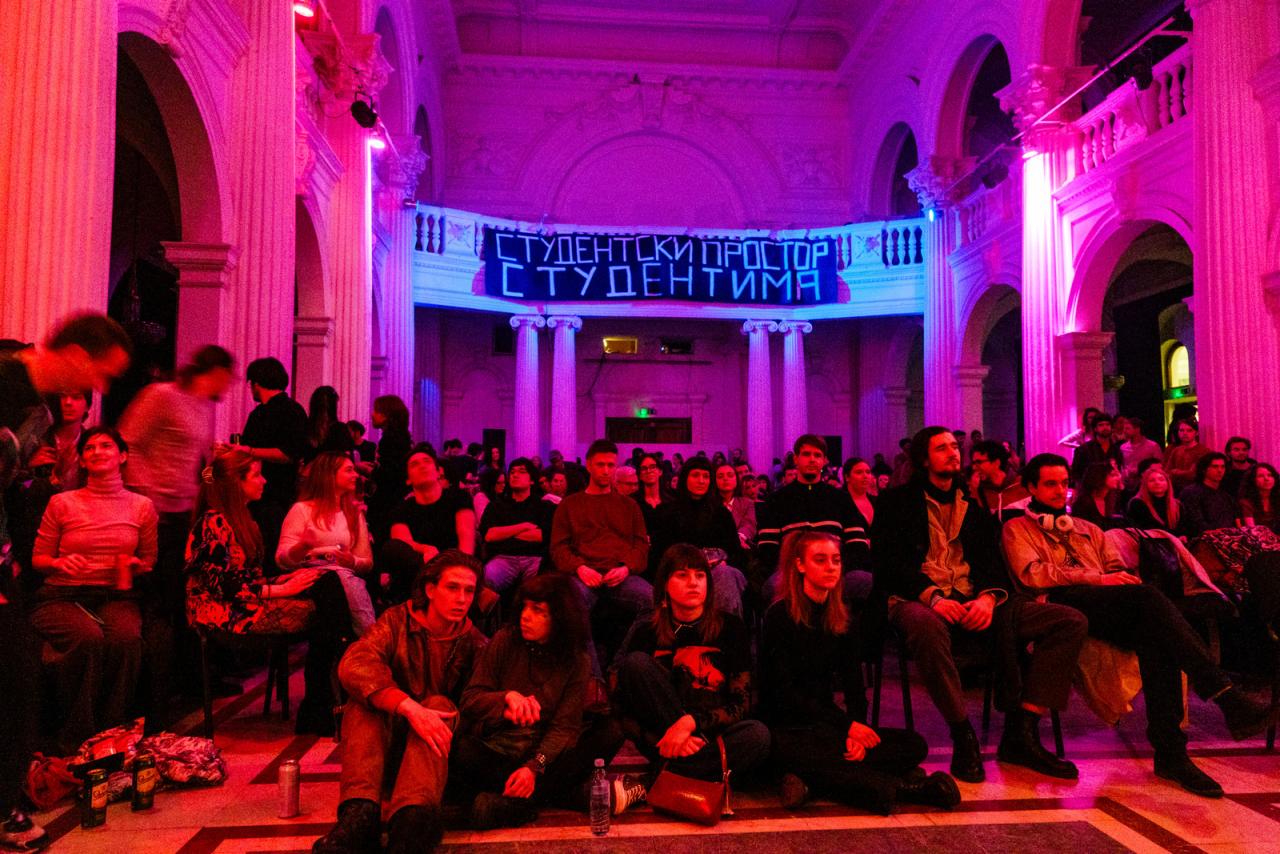
At the time of writing (October 2025) one of the most significant contemporary gestures of international solidarity with the people of Palestine is unfolding, followed in real time by transnational networks of supporters across progressive social media platforms. The Global Sumud Flotilla, carrying hundreds of activists from around the world, is on its way to the Gaza Strip, striving to deliver humanitarian aid to the Palestinian population. Among the many participants is a young visual artist from Serbia who volunteered to join this international act of solidarity. Ognjen Marković, a student at the Faculty of Fine Arts in Belgrade, joined the Flotilla out of a conviction that the cause directly concerns him. He is also one of the thousands of students who have taken part in organizing and sustaining the unprecedented mass student and civic protests in Serbia that have been ongoing since November 2024. During these months of protest, his involvement was particularly significant in connection with the Liberated Student Cultural Center in Belgrade.
The broader context of the mass protests
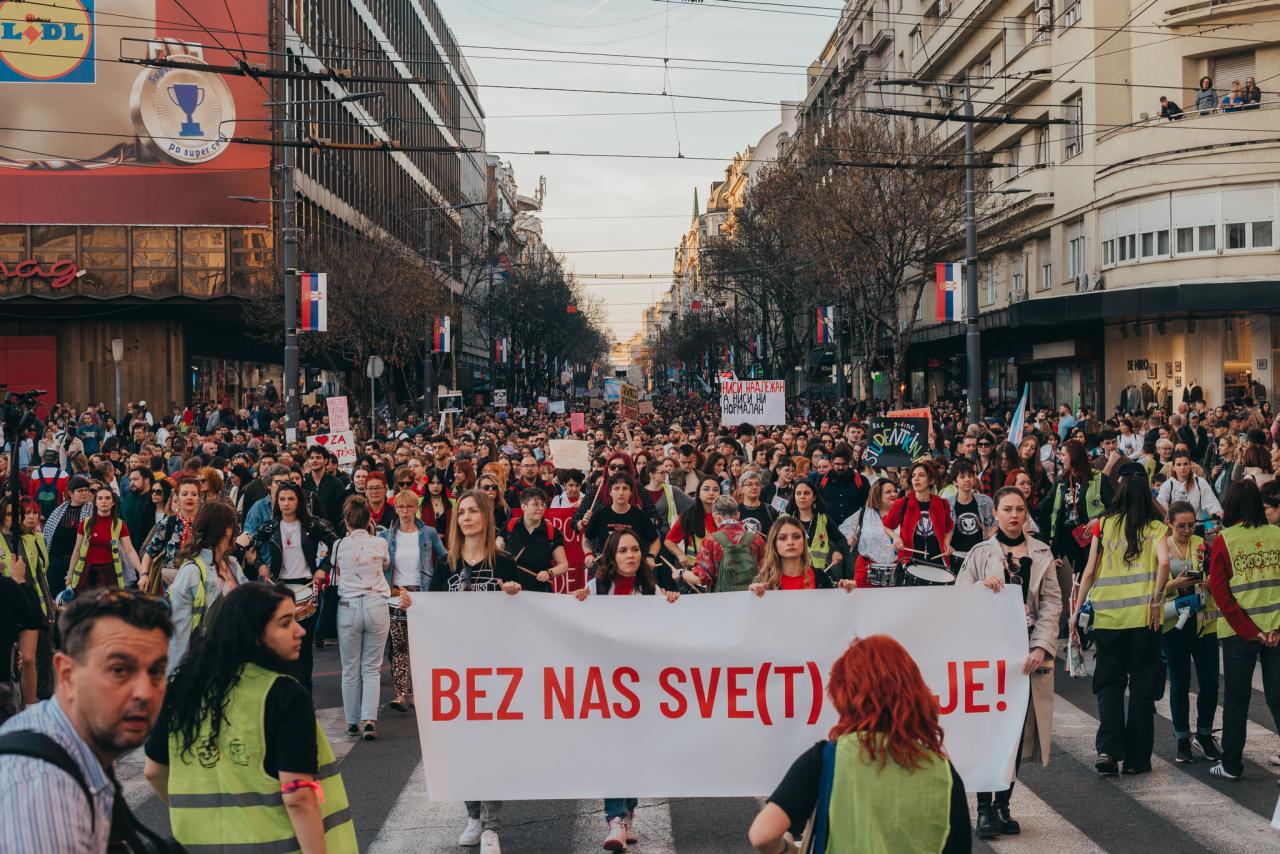
Despite the fact that mainstream media outlets in Serbia remain largely under the control of the ruling right-wing regime accused of corruption, students and citizens have successfully utilized social media as a tool for mobilization, expanding the protests and propelling society toward the articulation and pursuit of a more just, egalitarian and hopeful future. Over the past months of continuous protest, official student channels —and later, broader civic assemblies and their associated communication networks— have become central spaces for information dissemination, collective organization, and strategic coordination. The origins of the mass protests are linked to a tragic event that occurred on November 1st, 2024, when the canopy above the main entrance of the railway station building in Novi Sad collapsed, killing sixteen people, including several children. Under the slogan "Krvave su vam ruke” (“You Have Blood on Your Hands”), students and citizens demanded political and criminal accountability from the entire state apparatus.
These are the largest student and workers’ protests in Serbia’s recent history, with hundreds of thousands of participants taking to the streets in cities and towns across the country. 1 However, the roots of this public discontent are not confined to this singular event. Rather, they lie in the cumulative consequences of the thirteen-year rule of President Aleksandar Vučić and his Serbian Progressive Party (SNS), whose governance has been characterised by the erosion of democratic institutions, concentration of power, and pervasive social and economic inequalities. During this prolonged period, the fundamental labour and social rights of the majority of working people in Serbia have undergone a rapid and systematic deterioration. Shaped by neoliberal reforms tailored to Serbia’s structural position as a peripheral European economy, this model of capitalism has produced a regime of economic and political dependency that reproduces neocolonial patterns enforced in the context of ex-colonies —most visibly through the exploitation of cheap labour and the systematic disempowerment of workers to defend their basic rights.
The ruthless appropriation of natural and mineral resources along with the granting of long-term concessions over key public systems and agricultural land have been accompanied by consistent political support for a domestic comprador elite. This elite, itself a beneficiary of these exploitative processes, profits at the expense of the broader public good. As a consequence, Serbian society has been driven into deepening poverty and forced to “accept” persistently inadequate living conditions. Today, Serbia ranks among the European countries with the most severe levels of social inequality.
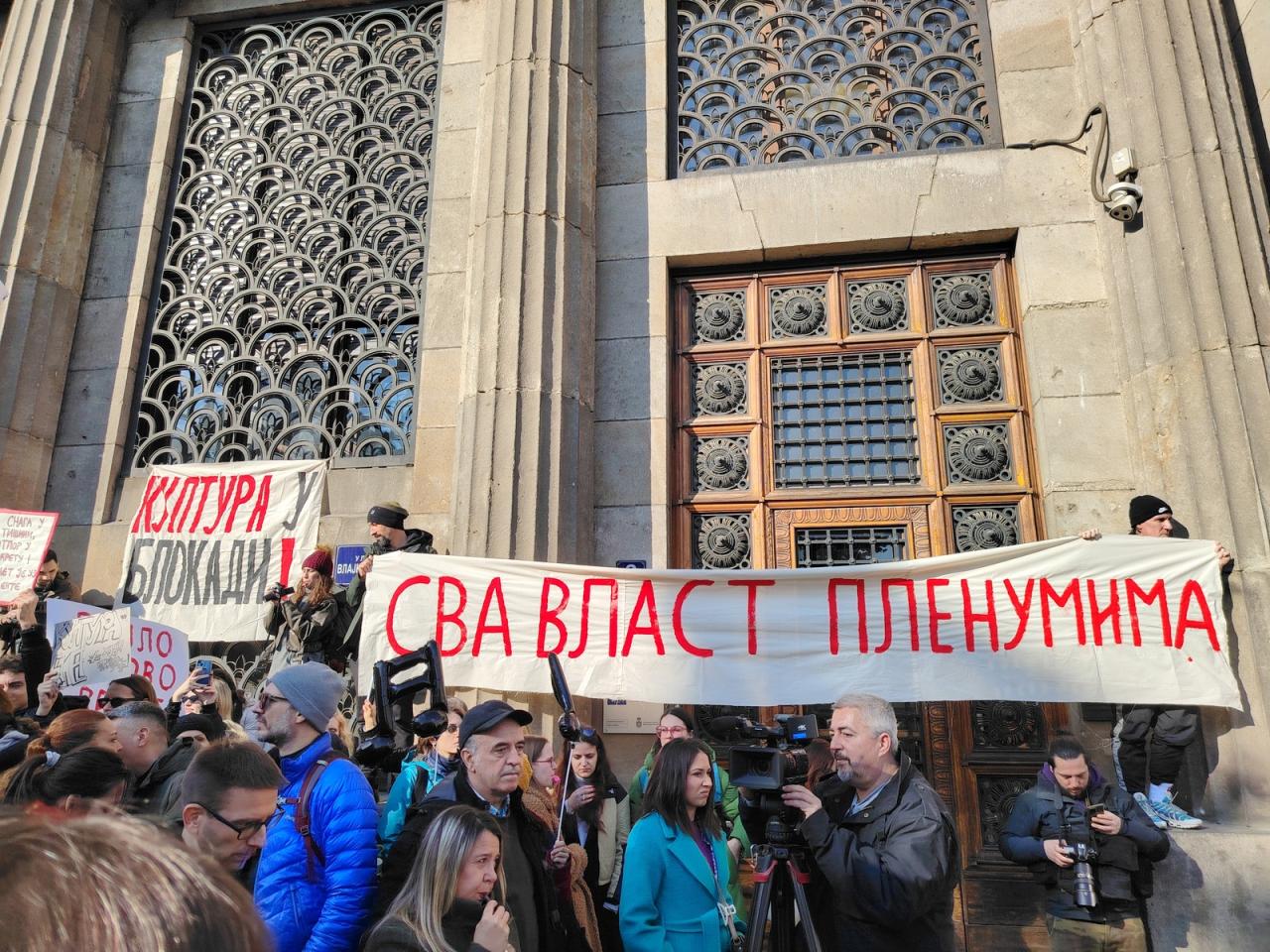
Amid the prevailing sociopolitical landscape, the ongoing mass student and civil protests have successfully catalysed a transformative ‘rupture’, that for many people across Serbia meant an intense period of self-organized practices, driven by social solidarity, resistance and a sense of shared struggles. A defining aspect of the student protests is their organization through plenums—direct-democratic assemblies in which decisions are made collectively by majority vote. This mode of self-organization is both deliberate and historically grounded, reflecting earlier traditions of student activism in the region. Throughout 2025, the faculty blockades of students occupying universities across the entire country was sustained by plenums forming the foundation of the movement’s endurance, mass mobilization, and broader political resonance, enabling other social groups to join the struggle. Calls for a general strike, work stoppages in various public and private sectors, hundreds of kilometers of student marches through villages, and the establishment of civil assemblies in every municipality are just some of the examples. Although some observers claim that the student movement has been hijacked by nationalists —pointing to occasional national and religious symbols and related rhetoric within the protests— there is a strong argument that focusing exclusively on these elements obscures what may in fact be a shift toward the left. As labour rights activist Vladimir Simović notes, what is emerging in Serbia is not a “narrow, ethnocentric mobilization, but something far more ambitious and harder to define: a pluralistic uprising rooted in direct democracy.” 2
Reclaiming (cultural) institutions
As the student perspective highlights the dysfunction of the general system and its institutions in Serbia, it also illuminates the systemic weaknesses of the cultural institutions that, for decades, have been on the verge of functioning, so to speak, due to the ‘state of emergency’. This state of affairs has further exposed the class inequities within the sector and revealed the extent and the consequences of the catastrophically articulated and even more poorly implemented state cultural policies, which have left many on the brink of financial ruin. Unacknowledged and invisible, these practitioners have long since become "the dark matter“ of the system, as defined by artist and theorist Gregory Sholette3. In the cultural sector, an exemplary case is students’ occupation of the Student Cultural Centre (SKC) in Belgrade, once a vital institution for youth and student culture, which is a very important initiative that inspired many more.
The self-organised students who occupied the Student Cultural Center (SKC), including the aforementioned Ognjen Marković, sought to reclaim it as a space for critical reflection, self-education, and collective creativity. Originally established after the 1968 student protests within Yugoslavia’s socialist self-management system, the SKC embodied principles of autonomy and participatory culture. Over time, however —and particularly through the neoliberal transformations of the 1990s and 2000s— the institution became detached from its founding mission, marked by non-transparent management and increasing commercialization. A key turning point came in 1993, when control of the SKC was transferred from the University of Belgrade to the Ministry of Education, effectively severing its link with the academic community. The current student blockade thus seeks to restore the SKC’s affiliation with the university and re-establish democratic governance that would return decision-making to students and faculty alike.
Common struggle
This entire social breakdown that is currently happening in Serbia opened up a space for the re-thinking and re-imagining of key social institutions as potentially different (more equal) social structures. Despite the strong revisionist tendencies imposed from above, transgenerational memories persist of the socialist self-management policies as well as the ones related to the Non-aligned movement that were practiced and experienced for decades after WWII. These policies brought emancipated knowledge and practice in various aspects of our lives, including in schools, workplaces, local communities and other forms of collective existence. The integration of this knowledge of previous generations into the fabric of our society enables today’s students to instinctively, affectively, spontaneously and intuitively comprehend the power of collective action.
In recent weeks, we have seen the emergence and spread of mass student and civil protests around the world —from Nepal to Peru— against their autocratic governments, but also against the global injustice that is unfolding before our eyes. The aforementioned student Ognjen Marković also writes about this in his diary notes documenting his experience of being on the Sumud Global Flotilla, published on the social networks of the official profile of the blockade of the Student Cultural Center in Belgrade 4. In these entries, he emphasizes the importance of recognizing that every act of resistance against imperialism and (neo)colonialism forms part of a shared, collective struggle. This is what the student plenums in Serbia hope for as well.
One world - one struggle!
Footnotes
1. For more on mass student protests in Serbia, see: Marijana Cvetković and Vida Knežević, “Mass Student Protests in Serbia: The possibility of different social relations”, L’Internationale Online, 2025. https://internationaleonline.org/contributions/mass-student-protests-in-serbia-the-possibility-of-different-social-relations/; Dušanka Milosavljević, “Serbian Students are Reimagining What Society Could Be”, Rosa Luxemburg Stiftung, 2025, https://www.rosalux.de/en/news/id/53167/serbian-students-are-reimagining-what-society-could-be; Saša Savanović, “The protests in Serbia are historic, the world shouldn’t ignore them”, https://www.aljazeera.com/opinions/2025/2/23/the-protests-in-serbia-are-historic-the-world-shouldnt-ignore-them.
2. See Vladimir Simović, "Serbia’s Student Movement Is Still Going Strong“ https://www.rosalux.de/en/news/id/53668/serbias-student-movement-is-still-going-strong
4. See official Instagram profile of the blockade of the Student Cultural Center in Belgrade: https://www.instagram.com/skc.u.blokadi/?hl=en