

Choose Transformation, Not Toxicity


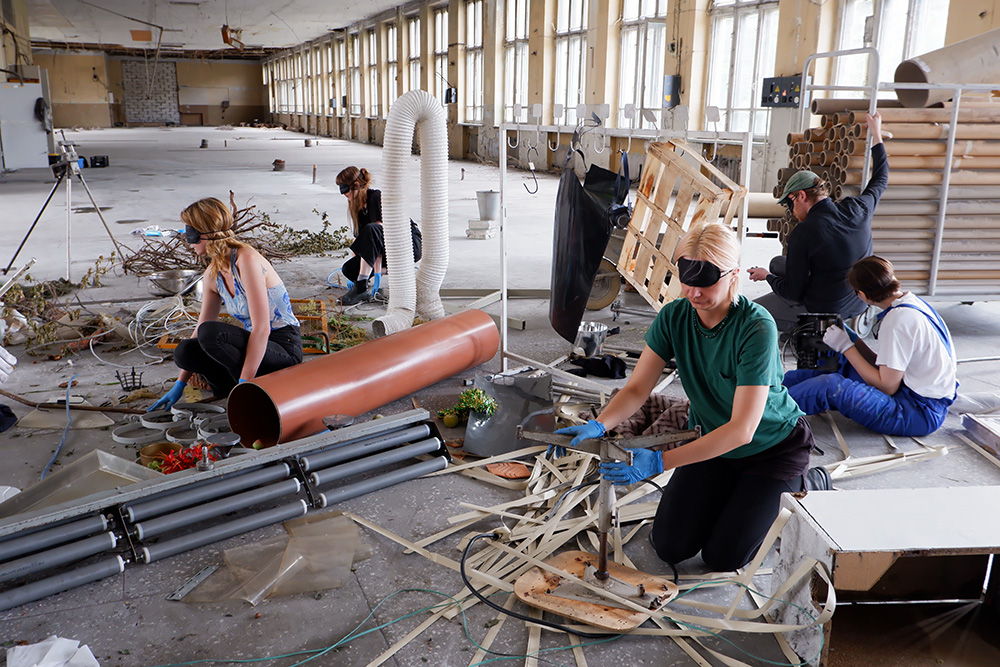
The transformational potential of workshopology1 has always emerged through communion with others. These communings bring forth experimentation, learning by doing, discourse-making, knowledge production, community, vulnerability and healing. Often interchangeable with studios, laboratories, kitchens, garages, and citizen spaces, workshopologies are physical gatherings where entangled transformation occurs among participants. These collective learnings can be about any topic imaginable, from citizen science, emerging technologies, food, environment, medicine, somatics —the list is endless. In today’s hyper-digitalized age, where identities, realities, and agencies are continuously stolen and distorted by state-corporate powers, practices like workshopology have the potential to restore people’s sovereignty and humanity. Because no matter what knowledge is knowledged, what matters is that we knowledged together. And through the experience of togetherness, we figure out what works and doesn't work under an ethos of love and care.
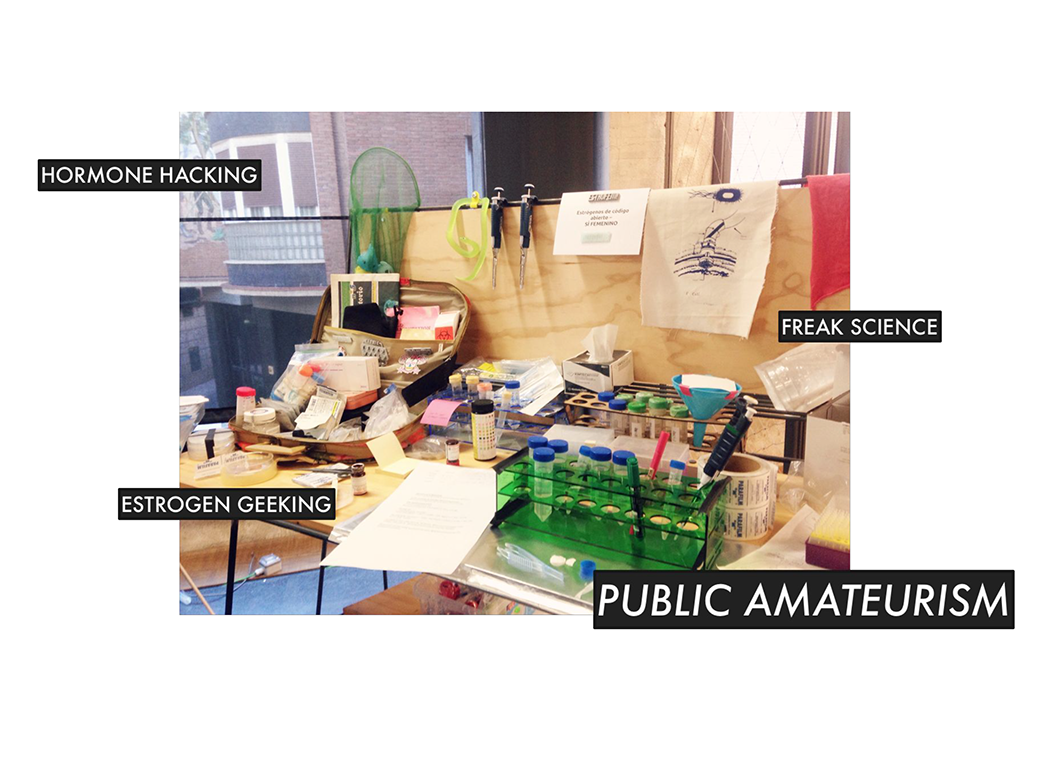
My immersion into the world of bioart, biohacking (synonymous with garage science, open source science, or do-it-yourself biology) and the practice of workshopology began in 2013 when I met U.S. collectives like Critical Art Ensemble and cyberfeminist group subRosa. These auto-didactic artists produced knowledge together through public amateurism, described by artist Claire Pentecost as the process of learning, doing, and failing in the public sphere, removing the hierarchy of the lay-person and expert. This way of experimenting in and with the public allowed these artists to challenge major scientific and biopolitical developments happening in the early 2000s, such as reproductive technologies, genetically modified organisms, eugenics, germ warfare, and the commodification of bodies.
Then in 2014, I travelled to Yogyakarta, Indonesia for HackteriaLab, a two-week, interdisciplinary gathering of over forty-five international artists, hackers, designers, engineers, and proud amateurs from a global online community. Organized in collaboration with the local collective Lifepatch —citizen initiatives in art, science and technology, the HackteriaLab gathering brought people together to hack on local ecological research nodes: biodiversity conservation, bioremediation2 of volcanic soil, and the pollution of an urban river. It was there in that humid environment of frenetic and creative energy that I first heard the word workshopology. At the time, workshopology related to the iterative prototyping of machines, devices, protocols, instruments, recipes, and artistic projects in a participatory way. This collaborative feedback process resembled a musical jam session, where the talents and instruments of each player created in the most emergent way, a new song.
With the project Open Source Estrogen (2015), I began creating my own practice of workshopology centered on biohacking. From the initial question of “what if we could make estrogen in the kitchen” came DIY, accessible “freak science” protocols for detecting estrogens with yeast biosensors, extracting hormonal molecules from urine, and bioremediating toxicities with species of white-rot fungi. Through multi-disciplinarity with multi-beings, these protocols were created collaboratively through several prototyping “open-lab” residencies with friends in the Hackteria network, GynePunk Lab, the Aliens in Green, and beyond.
Initially, biohacking was used as an artistic methodology for demystifying hormonal molecules and their constructed notions of gender, sex, and reproduction, and eventually environmental toxicity and the ecological “normal.” But what biohacking was actually doing was revealing the most hidden, existential traps that dominate our world. These traps are the binary logics of normal and abnormal, cleanliness and dirtiness, purity and toxicity, resulting in the impossible-to-ignore alienations felt in the body and in the environment. I’ve articulated these traps as consequences of living in the Estroworld, a double trauma of alienation and the paralyzing inability to figure a way out. Biohacking became hacking the origins of trauma itself. Ten years later, after giving dozens of workshops around the world, I believe Open Source Estrogen came to me fatefully to be developed as a case study in workshopology and its collective potential for undoing the traps of the Estroworld.
We all have a profound capacity to create our world, but many of us are living blindly or in a state of collective malaise. We keep building the same structures that eventually fall apart. Meanwhile, security and prophylactics have become a global obsession, even though they are a complete illusion and rooted in the frequencies of fear. As a result, we turn to mass consumerism enabled by what artist and writer Gary Zhexi Zhang describes in his essay in Catastrophe Time! as a false free market built on contingency and catastrophe narratives, with the one percent profiting off of the “global conditioning of psycho-social delusions” (Zhang, 2023, 38). Industrial molecules of the Anthropocene don’t choose to be agents of toxicity and trauma, in the same way that we never consent to harm and pain, in the same way that the first estrogen receptor to evolve with the first vertebrate species never intended to bind to the chemicals we produce today, 550 million years later. Yet how are we still suffering from their presence? How are we still masters of our own lovelessness?
The first step in confronting our suffering means awakening to love. As feminist scholar bell hooks articulates in her classic book, All About Love in the chapter “Greed: Simply Love,” material accumulation is a symptom of the lovelessness that plagues our society. Like what we’ve witnessed with war, poverty, and planetary extraction, insatiable greed is what normalizes domination and “violates the spirit of connectedness and community that is natural to human survival” (hooks, 1991, 117). What must actually erode are the barriers of lovelessness that alienate us from surviving together, with each other and with our home planet. To reconnect to our planetary wounds means learning to love from our own wounds of alienation.
As I studied the Estroworld more and more, I realized that molecules, microplastics, chemicals, rocks, diatoms, waste —all matter, living and non-living— undergo their own fated collisions. Entanglements initiated by proximity and physical contact, this performativity of matter is a co-productive process, held together by the same stickiness that holds participants in a workshopology together. One can even say that it is a desire for love, interconnection and survival that keeps matter bound together in transformation. Matter’s fate, like my own, has always been tied to the fate of others. The stickiness of workshops, not necessarily the technical knowledge and prototypes, are what hold our fated collisions together. The question we need to ask is whether we are willing to commune with the alien, to stand in our own fire and fear, and transmute the wound that fatefully binds us all. Only from learning to love from our shared wounds can we find safety in alienation.
It is no coincidence that the word amateur contains the Latin root “ama-” for the word love. As (proud) amateurs, we practice what we love and share it openheartedly to cross-contaminate with each other in the moments of workshopology. As I wrote before, workshopology is where we learn what works and doesn't work under an ethics of care. Negotiating personalities, backgrounds, desires, resources, emotions, and cosmo-visions, an ethics of care is what we need to harmonize all of these factors. Care for the material, care for our tools, care for the people and their emotions, care for the land-bodies, environments, and the planetary —these are the experiential and non-quantifiable vulnerabilities in collective practices that cannot be scaled-up in capitalistic terms. Without love and the intimacy of togetherness, we forgo the momentum that keeps collectivities not only surviving, but re-existing through struggle.
In all of my workshops, with every person who entered into a fated collision with me, I’ve delivered the message, “choose transformation, not toxicity.” The cross-contaminating, porous, collaborative process of workshopology has the power to override fear because it is expansive. It permeates through the barriers of our skin and cracks us open to bigger possibilities while sticking us together. We amplify our power when we unify our pluriversal visions. These unified visions can be so disruptive and irreverent to the current status quo that they refuse, challenge, and re-make our old-world paradigms. Therefore, new ways of transmuting together become new paths to our collective liberation.
Bibliography
hooks, bell. 1999. All About Love: New Visions. New York: Harper Perennial.
Zhang, Gary Zhexi. 2023. Catastrophe Time! MIT Press.
Footnotes
1. The iterative process of performing workshops where feedback from the participants evolves the workshop itself. Beginning as a colloquial term in the global online Hackteria network, it slowly emerged as a practice and research methodology for artists and interdisciplinary collaborations.
2. A process that uses the natural metabolic mechanisms of living organisms such as fungi and microbes to neutralize contaminants and pollutants in soil, water, and air.